Neglected Underutilized Species for Water Harvesting and Building Climate Resilience
NUSTALGIC is a PRIMA-funded project that aims to revitalize traditional crops and practices to strengthen the sustainability of Mediterranean dry-farming systems. By merging scientific innovation with local knowledge, the project supports farmers in adapting to water scarcity, climate change, and soil degradation, ensuring both food security and ecosystem health.
NUSTALGIC focuses on four main objectives:
Increasing water harvesting and efficiency.
Diversify agricultural systems, improve soil health and enhance resilience to climate change.
Create job opportunities and develop new products and value chains using NUS.
Implement a robust multi-stakeholder engagement strategy across diverse sectors and levels.
Approach
NUSTALGIC is a PRIMA-funded project that aims to revitalize traditional crops and practices to strengthen the sustainability of Mediterranean dry-farming systems. By merging scientific innovation with local knowledge, the project supports farmers in adapting to water scarcity, climate change, and soil degradation, ensuring both food security and ecosystem health.
Expected Impact
NUSTALGIC will generate tangible environmental, scientific, and social benefits, including:
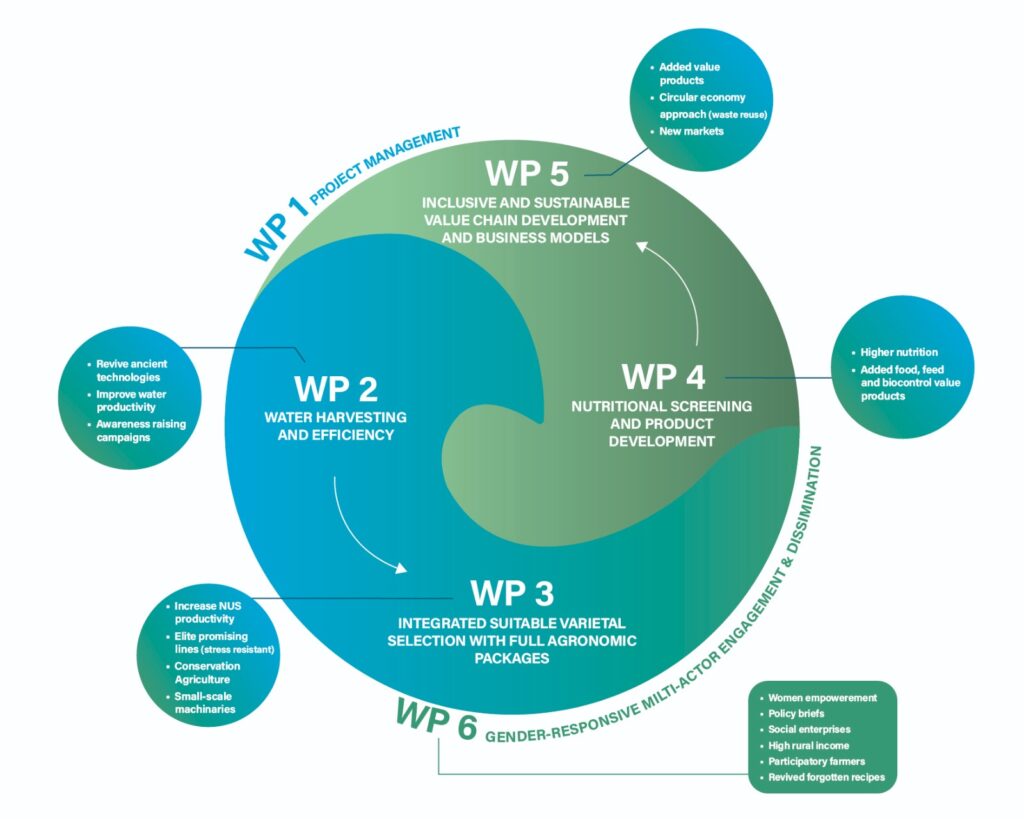
WP1: Project management and scientific coordination
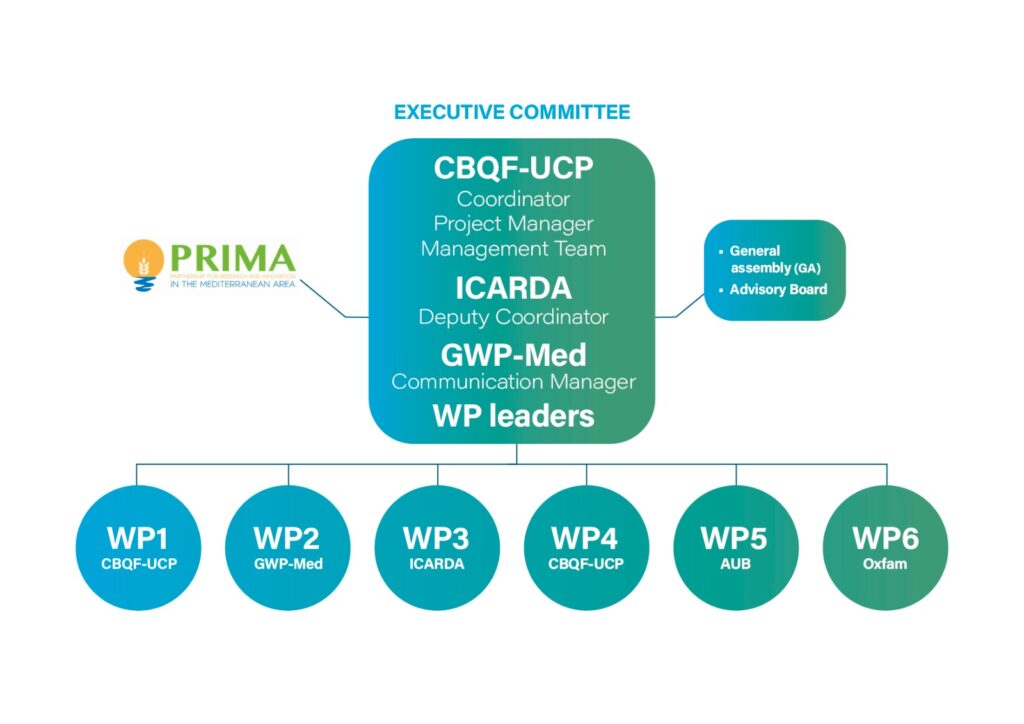
Leader CBQF-UCP, co-leader ICARDA. And with the contributions of all partners.
Main objectives:
Organization, coordination and financial management of the project
Development of quality management plan, risk management and data management plan
Coordination and development of a Soil Task Force
Development of a Gender Task Force
Tasks:
General and Financial Management
Quality Management and Risk Management
Data Management
Coordination measures and joint activities with the “Soil Deal for EUROPE”
Gender Task Force
WP2: Water harvesting technologies
Leader GWP-Med, co-leader MIRRA. And with the contributions of all partners.
Main objectives:
Identify and involve all key stakeholders for achieving the overall objectives.
Select water harvesting technologies and co-design packages with the stakeholders (especially farmers).
Deploy the designed water harvesting technologies on demonstration sites.
Promote stakeholder ownership for the sustainability of selected techniques beyond the project timeline.
Evaluate the performance of the deployed water harvesting technologies and finalize their design.
Tasks:
Multi-actor assessment of water harvesting technologies
Design and Deployment of Water Harvesting Technologies
Monitoring and Evaluation of Water Harvesting Technologies
WP3: Integrated suitable varietal selection with the full agronomic packages
Leader ICARDA, co-leader CSIC. And with the contributions of all partners.
Main objectives:
Test and scale elite promising lines of barley, chickpea, grasspea, faba bean and lentils.
Integrate agronomic practices for barley, chickpea, grasspea, faba bean and lentil and vetches during crop rotations or intercropping, as validated and demonstrated in farmers’ fields.
Characterize and identify biotic resistance and abiotic stress tolerance available in barley, faba bean, chickpea, lentils, and cactus.
Introduce small-scale machinery for NUS crops in farming communities to reduce labor cost and improve agronomic practices.
Improve soil health parameters (including soil organic matter, carbon sequestration, water retention) by adopting legumes-cereal crop rotation and intercropping with minimum tillage.
Tasks:
Testing and scaling elite promising lines of legume and cereals
Testing the performant agronomic packages on selected legumes lines
Characterization of stress resistant NUS crops
Popularizing the use of small-scale machinery for better crop management and reduced labor
Monitoring soil health in each of the demonstration sites where legumes are grown
WP4: Nutritional screening and product development
Leader UCP, co-leader LARI. And with the contributions of all partners.
Main objectives:
Conduct a comprehensive nutritional screening of raw material obtained from WP3
Develop and Formulate product prototypes using NUS-based food products
Develop and Formulate feed product prototypes
Characterize the nutritional value and sensory quality evaluation of NUS-based food products
Evaluate the viability of waste from selected NUS within the circular economy approach as innovative biocontrol and biopesticide compounds and products
Tasks:
Nutritional assessment of raw materials
Development of NUS-based food products
Development of NUS-based feed products
Nutritional value and sensory attributes of NUS-derived products
Valorization of NUS Waste for Biocontrol and Biopesticide Development
WP5: Inclusive and sustainable value chain development and business models
Leader AUB, co-leader OXFAM. And with the contributions of all partners.
Main objectives:
Determine and pilot the market opportunities for cactus, dry lentil, and faba bean products and by-products through comprehensive market analysis and direct support to enterprises with a high social impact and inclusive business models
Compare the environmental impact of products developed from NUS with those from traditional crops
Assess the feasibility and profitability of new products and by-products for small food producers by conducting detailed life cycle cost analysis
Evaluate consumer willingness to pay for tangible and intangible attributes of new products and by-products through intercept surveys and choice experiments
Establish direct links between producers, urban consumers and enterprises by developing targeted marketing strategies and creating digital platforms
Tasks:
Social and circular business models and new products and by-products
New products and by-products environmental impact and full cost estimation
Intermediate and final consumers’ willingness to pay for tangible and intangible attributes of new products and by-products
Creating links with urban consumers for the new products and by-products
WP6: Gender-responsive multi-actor engagement and dissemination
Leader OXFAM, co-leader ICARDA. And with the contributions of all partners.
Main objectives:
Engage multiple stakeholders using DRIPS to generate income and gender-transformative solutions for NUS crop cultivation (integrating agricultural practices for water, agronomy, and soil management) and consumption
Empower women in agriculture by recognizing their contributions, addressing gender disparities, and promoting leadership opportunities
Create and disseminate communication materials in multiple languages showcasing the social, economic, and technical innovation bundles of NUSTALGIC for key stakeholders in the participating countries and other interested parties
Tasks:
Engagement of farmers in the co-creation and dissemination of technological packages
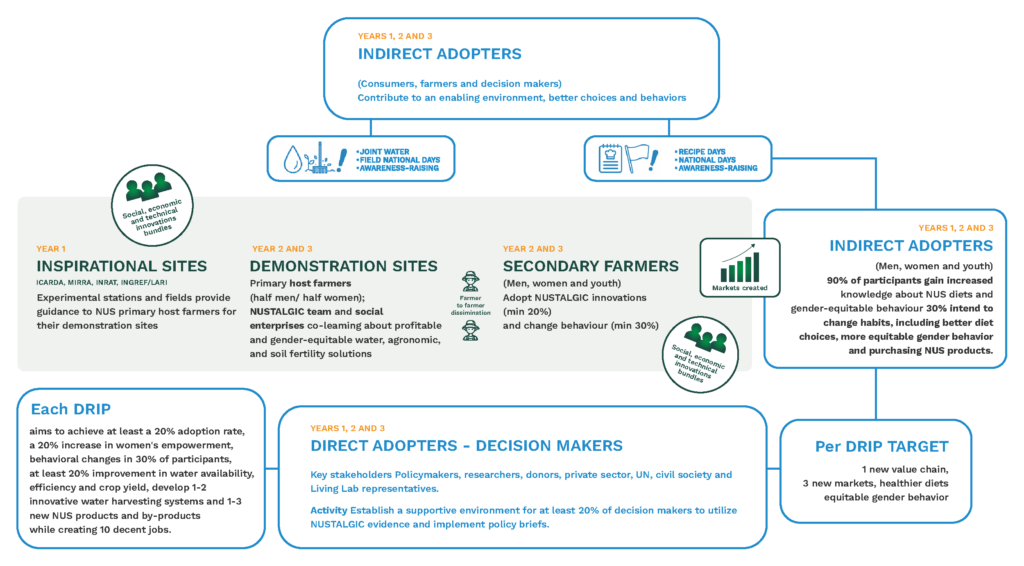
DRy-farming system multi-actor Innovation PlatformS (DRIPS) are collaborative hubs established across target regions to test, demonstrate, and scale climate-smart solutions for neglected and underutilized species (NUS). Each DRIPS brings together farmers, researchers, policymakers, and industry actors to co-develop practices such as water-harvesting technologies, conservation agriculture, and NUS-based value chains.
Why DRIPS Matter in NUSTALGIC?
DRIPS ensure that innovations are technically sound, economically viable, socially inclusive, and particularly beneficial for women and smallholder farmers. They play a central role in NUSTALGIC’s mission by enabling real-world implementation, accelerating adoption in surrounding communities, and supporting the dissemination of successful approaches at national and international levels.
DRyfarming system multi-actor Innovation PlatformS (DRIPS)
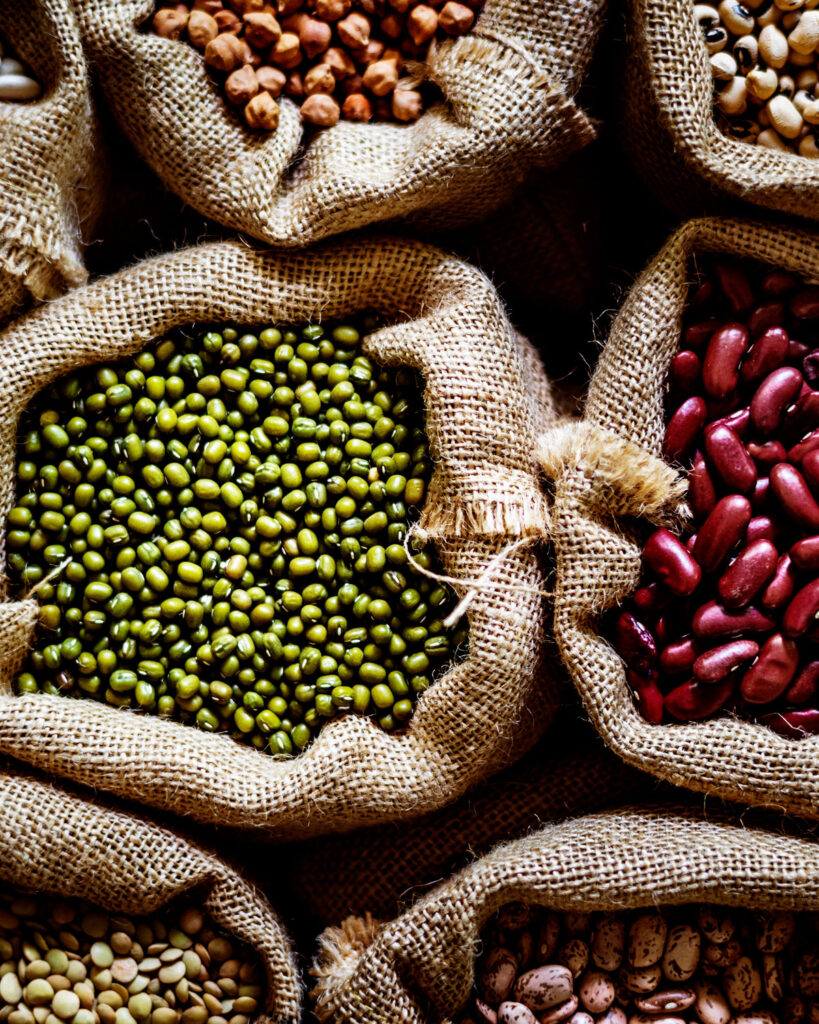
Known for its high protein and fiber content, chickpea is a staple of Mediterranean cuisine and a key crop in climate-smart agriculture, capable of growing under limited rainfall.
Lentil
Lens culinaris
A cornerstone crop in Mediterranean diets, lentils are nutrient-rich, quick-maturing, and thrive in semi-arid conditions. They improve soil health and are increasingly used in sustainable food innovations.
Barley
Hordeum vulgare
A versatile and drought-tolerant cereal cultivated for food, feed, and brewing. In dry-farming systems, barley is crucial for soil conservation and provides a basis for innovative food and by-product development.
Vetches
Used mainly as forage or cover crops, vetches contribute to soil nitrogen enrichment, erosion control, and livestock feed quality, supporting integrated crop-livestock systems.
Faba bean
Vicia faba L.
A nutrient-dense legume rich in protein, fiber, and minerals, used in both human diets and livestock feed. Faba bean enriches the soil with nitrogen, supporting sustainable cereal–legume rotations in rainfed farming systems.
Grass pea
Lathyrus sativus
An ancient, drought-tolerant pulse valued for its high protein content and ability to grow in poor, dry soils. Grass pea offers food and feed security in marginal environments while preserving traditional agrobiodiversity.
Drought-tolerant cacti
Highly resilient plants adapted to arid environments, cacti are used for fodder, food, and soil restoration. Their ability to store water and grow on poor soils makes them vital for climate adaptation and combating desertification.
OXFAM Italy (OIT) is part of an international confederation of 21 organizations. OXFAM works in the MENA region to deal with the impact of climate change, inequality and poverty and promote gender equality. OXFAM promotes social entrepreneurship with innovative, sustainable solutions through humanitarian relief, development programmes and influential advocacy.
Address: Via Concino Concini 19, 52100 Arezzo (AR), Italy
MIRRA
Based in Amman, Jordan, the Methods for Irrigation and Agriculture (MIRRA) association is a non-profit organisation dedicated to promoting water-efficient and climate-resilient agriculture. MIRRA develops and implements innovative solutions for sustainable irrigation, improved water governance, and enhanced agricultural productivity, particularly in dryland environments. Through applied research, technology demonstration, and stakeholder training, MIRRA translates science and engineering into practical tools that support farmers and rural communities.
Recognised for its strong contribution to capacity building and environmental sustainability, MIRRA collaborates closely with local authorities, research institutions, and international development partners. Its projects address critical challenges such as water scarcity, soil degradation, and food security, helping to accelerate the adoption of resource-efficient practices across the region.
Based in Beirut and Byblos, Lebanon, the Lebanese American University (LAU) is a private, non-profit American-chartered institution offering a wide spectrum of undergraduate, graduate, and professional degrees.
The university emphasises student-centred learning, international outlook, and strong industry and civic engagement, placing it among the highest-ranked institutions in the Arab region. LAU houses expertise in water resource management, climate change ecology and adaptation, social-ecological analysis, economics and political economy and stakeholder engagement.
Based in Tal Amara, Bekaa Valley, Lebanon, the Lebanese Agricultural Research Institute (LARI) is a governmental research organisation under the jurisdiction of the Ministry of Agriculture, founded in 1957.
The institute focuses on applied agricultural research aimed at improving productivity, sustainability and resilience in Lebanon’s agro-ecosystems — especially for marginal lands, agroforestry systems, olive and grazing landscapes.
LARI collaborates with universities, local farming communities and international development programmes to facilitate technology transfer, field trials and capacity-building for farmers and stakeholders.
Based in Tunis, Tunisia, INRGREF is a public multidisciplinary research institute established in 1996 and operating under the aegis of the Tunisian Institution of Agricultural Research and Higher Education (IRESA). It addresses key national priorities in rural engineering, water management, and forestry by conducting research in four specialised laboratories (rural engineering; non-conventional water use in agriculture; forest resources management; forest ecology) and operating seven experimental stations across different ecological zones.
INRGREF offers advanced training, hosts workshops and conferences, and maintains collaborations with over 50 international organisations in Europe, Asia, the MENA region and the USA.
Address: Rue Hédi EL Karray El Menzah IV, 1004 Tunis BP 10, Ariana 2080, Tunisia
INRAT
Based in Tunis, Tunisia, the National Institute of Agronomic Research of Tunisia (INRAT) is a public research institution dedicated to strengthening agricultural productivity and sustainability, particularly in Mediterranean and arid environments. INRAT advances crop and livestock improvement, natural resource management, and food systems innovation, providing scientific expertise to support national food security and informed policymaking.
INRAT collaborates closely with universities, extension services, farmer organisations, and international research networks. With experimental stations and specialised laboratories, the institute delivers applied research, demonstration activities, and capacity-building initiatives that help translate innovation into practical solutions for the agri-food sector.
Address: Rue Hédi Karray, CP 2049 Ariana, Tunisia.
AUB
Based in Beirut, Lebanon, the American University of Beirut (AUB) is a leading academic and research institution recognized for its contribution to sustainable development and community resilience in the Middle East. Through multidisciplinary expertise in agriculture, food systems, environmental sustainability, and rural innovation, AUB focuses on innovative education methods, advanced research, and effective community engagement. The university maintains strong collaboration with farmers, policymakers, and industry stakeholders to ensure that new technologies and practices are effectively transferred from research to implementation.
The Institute for Sustainable Agriculture (IAS-CSIC), based in Córdoba, Spain, is part of the Spanish National Research Council (CSIC) and is the country’s largest public research institution, comprising over 130 research institutes nationwide.
IAS-CSIC works to make food production compatible with environmental protection and natural resource conservation, contributing to the long-term sustainability of Mediterranean agriculture. The institute has extensive experience in legume and cereal research, with active germplasm collections and breeding programs that support crop improvement and biodiversity preservation.
Its facilities include a modern experimental farm, growth chambers, greenhouses, and fully equipped laboratories, enabling cutting-edge research from field to molecular level.
Address: Instituto de Agricultura Sostenible, Avenida da Menendez Pidal, 14004 Cordoba, Spain
GWP-MeD
Global Water Partnership – Mediterranean (GWP-Med) was established in 2002 as the Mediterranean Regional Water Partnership of the Global Water Partnership (GWP) Network. GWP-Med extends its human resources in 7 Mediterranean countries with the Secretariat being based in Athens.
Aiming for a water-secure Mediterranean, GWP-Med works at the regional, transboundary, national, basin and local level. GWP-Med promotes action and facilitates dialogue on Integrated Water Resources Management (IWRM); provides technical support to policy making; implements demonstration activities; and contributes to skills and knowledge development. Gender and youth issues, as well as private sector participation in water financing, are also key, cross-cutting issues for GWP-Med.
GWP-Med facilitates a multi-stakeholder platform that brings together almost 100 water institutions and organisations, including 10 major regional networks of different water disciplines.
ICARDA is an international research-for-development organization dedicated to advancing agriculture in dry and semi-arid regions worldwide.
With a mission to support resilient livelihoods under climate stress, ICARDA operates across Asia, Africa and the Middle East, providing science-based solutions in crop improvement, integrated farming systems, and resource-efficient agronomy.
The organization is recognized for its significant contributions to food and nutritional security, evidence-based policy, and its commitment to inclusive innovation for smallholder farmers. Gender equality, youth engagement, and integrated value-chain participation are also embedded as cross-cutting priorities in ICARDA’s work.
ICARDA convenes extensive multi-stakeholder partnerships which link national research systems, universities, NGOs, private sector actors and donor agencies. Through these networks, the organization delivers improved crop varieties, knowledge products and practice-oriented models for resilient dry-land agriculture.
Address: Bashir El Kassar Street, Verdun 1108-2010, Beirut, Lebanon
UCP-CBQF
Based in Porto, Portugal, Universidade Católica Portuguesa (UCP) hosts the Centre for Biotechnology and Fine Chemistry (CBQF), a leading research unit dedicated to advancing knowledge in agri-food, environmental sustainability, health, and well-being. Recognized for its strong social impact and contributions to evidence-based policy, CBQF fosters innovation that connects science with real-world challenges. Committed to open science, UCP encourages researchers to make their work publicly available through its open-access repository Veritati, integrated in the national platform RCAAP. Over the past five years, CBQF has participated in more than 130 national and international R&D projects, funded through H2020, PRIMA, COST, LIFE-ENV, CYTED, IBEROEKA, and FCT, consolidating its position as a key player in European research and innovation.