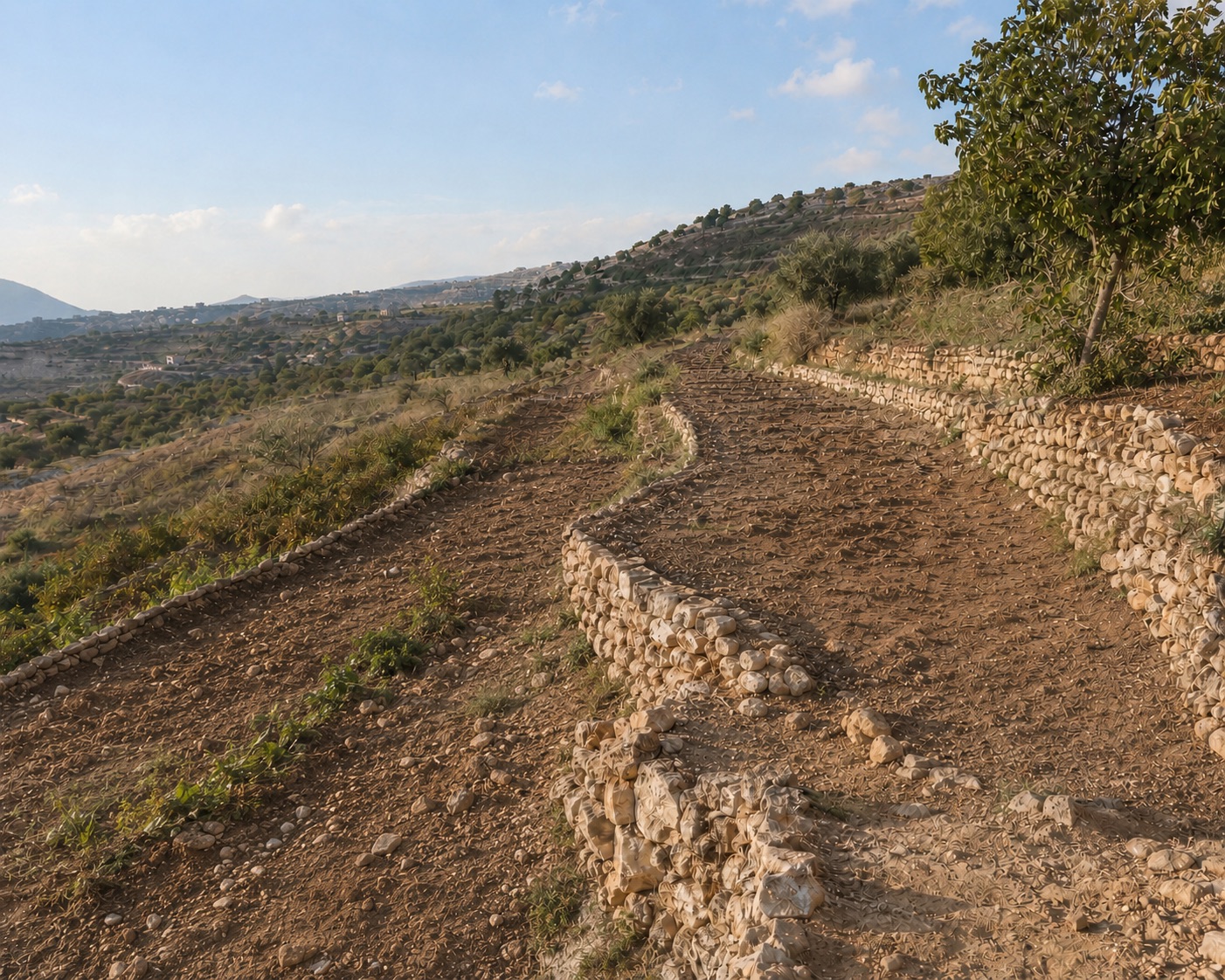
As part of NUSTALGIC, the Lebanese American University (LAU) Office for Sustainability is working with local communities in Lebanon on water harvesting and climate-resilient agriculture. We spoke with the team about what they are hearing from farmers, the challenges of implementation, and the role of traditional knowledge in climate adaptation.
What are you hearing from farmers and local stakeholders?
Farmers and local stakeholders are strongly aware of the increasing pressure caused by water scarcity, irregular rainfall, and the rising cost of irrigation. Many of the practices promoted by NUSTALGIC, such as terraces and rainwater harvesting, are familiar to them because they are linked to traditional and ancestral agricultural knowledge.
At the same time, farmers recognize the need to modernize these practices to make them more efficient and better adapted to current climate conditions. Many hope that NUSTALGIC will help reduce dependence on limited water sources, improve soil moisture, lower irrigation costs, and maintain agricultural production during dry periods.
What are you working on right now?
The team has conducted field visits, engaged with farmers and local stakeholders, collected assessment data, and applied a scoring mechanism to support the selection of suitable participants.
The next steps include finalizing the technical design of the selected technologies and preparing for implementation with the selected farmers.
Has anything changed your perspective so far?
What has been most interesting so far is the strong link between innovation and local heritage. Farmers are not only interested in technical support; they are also proud to reconnect with practices used by previous generations, such as terraces and traditional water management systems.
This has confirmed that successful climate adaptation is not only about introducing new technologies, but also about respecting local knowledge and adapting it to today’s environmental and socio-economic realities.
What is one challenge you are facing on the ground?
One key challenge is managing expectations while ensuring a fair and transparent selection process. Many farmers are interested in participating, but the project can only support a limited number of pilot sites.
This makes communication especially important, particularly when explaining that selection is based on objective criteria such as land suitability, vulnerability to water scarcity, technical feasibility, and willingness to engage.
How does this work connect to your experience as a researcher or institution?
This work builds directly on the LAU Office for Sustainability’s experience in water resources management, climate change adaptation, sustainability, and stakeholder engagement.
Through NUSTALGIC, the team is translating research experience into practical field-based solutions that respond to farmers’ needs. The project also strengthens LAU’s role in connecting science, communities, and policy through locally adapted water harvesting solutions that can support more resilient agricultural practices in Lebanon.
About the LAU Office for Sustainability
The LAU Office for Sustainability works on climate adaptation, water management, sustainable agriculture, and community-based environmental solutions in Lebanon and the wider region. The NUSTALGIC team includes Nadim Farajalla, Manale Abou Dagher, and Ramy Sakr, bringing expertise in sustainability, climate policy, stakeholder engagement, and field implementation.
Nadim Farajalla, PhD. – Chief Sustainability Officer: Dr. Farajalla is a leading climate policy and environmental governance expert with over 30 years of experience in climate change research, institutional advisory work, and policy development in Lebanon and the region. As the inaugural Chief Sustainability Officer at LAU and former Founder and Director of the Climate Change and Environment Program at AUB’s Issam Fares Institute, he brings deep expertise in climate governance, public policy, and inter-ministerial coordination essential for shaping national climate legislation.
Manale Abou Dagher, M.Sc. – Lead Sustainability Coordinator: Mrs. Abou Dagher is an experienced sustainability and environmental program specialist with more than 18 years of experience spanning academia, research institutions, and policy-oriented organizations, with deep expertise in climate change, environmental governance, coastal resilience, and sustainable development. In her role as Lead Sustainability Coordinator at LAU, and previously as Program Manager at AUB’s Issam Fares Institute, she has led multidisciplinary projects, contributed to national and regional climate initiatives, and managed high-level stakeholder engagement, capacity building, and research programs across Lebanon and the MENA region.
Ramy Sakr, M.Sc. – Lead Project Coordinator: Mr. Sakr is an environmental and livelihood specialist and project manager with over 14 years of experience in climate change, biodiversity, and sustainable development projects in Lebanon. He has successfully managed large-scale, donor-funded programs with international organizations (UNDP, FAO, USAID, WFP), demonstrating strong expertise in project coordination, stakeholder engagement, and capacity building. His recent role at the Office for Sustainability (LAU) further strengthens his experience in aligning projects with institutional and national climate frameworks.